interviews
Tash Aw & Tahmima Anam Discuss Home, Identity and the Changing Face of Asia
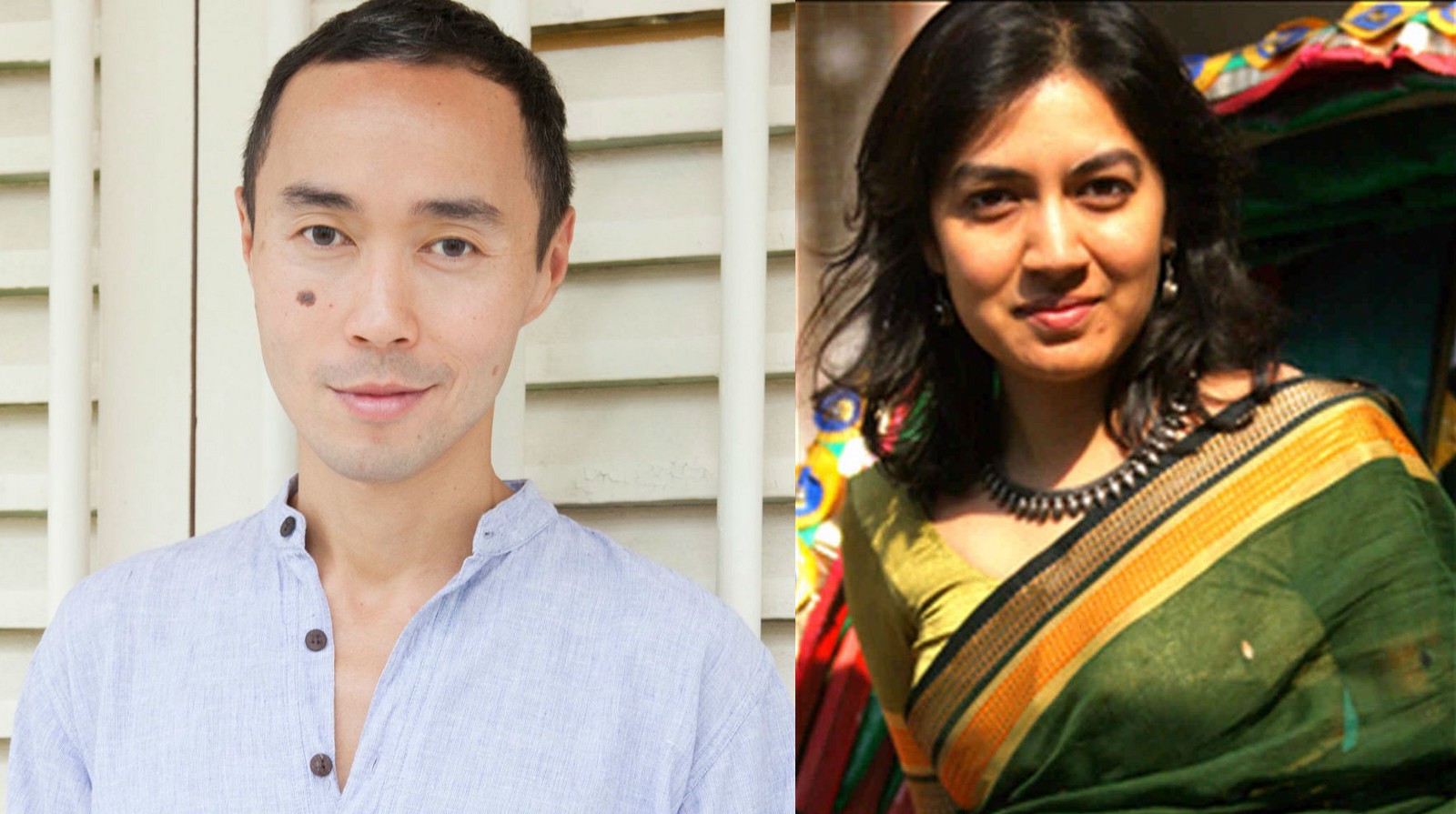
Tash Aw, the author of three critically acclaimed novels, The Harmony Silk Factory (2005), Map of the Invisible World (2009), and Five Star Billionaire (2013), as well as a new contribution to the short memoir series The Face (Restless Books), was born in Taipei to Malaysian parents and grew up in Kuala Lumpur before moving to Britain to attend university. Tahmima Anam, the author of A Golden Age, which won the Commonwealth Writers’ Prize for Best First Book, was born in Dhaka, Bangladesh, and grew up in Paris, Bangkok, and New York.
They recently corresponded by email and were kind enough to share with us their conversation, in which they discuss issues of identity, leaving home and family, class, commercialism, and the past and future of Asia.
Tahmima Anam: In The Face: Strangers on a Pier, you express a deep ambivalence about Malaysia — on the one hand, you are uncomfortable with its excesses, with the way that class and power have played out in the years since you grew up there. And yet, Malaysia persists, in a big way, in your imagination — not only here, in your examination of your past, but also in your fiction. Can you talk a little more about that — and do you wish, ever, for a simpler relationship to “home”?
I like progress, I liked the idea of an Asia that grows richer in every sense with each generation; but I also believe in the idea of possibility.
Tash Aw: I think if anyone is truly honest about any meaningful relationship, they will experience a certain ambiguity about it: no one can love totally without questioning that relationship from time to time, and if they did, it wouldn’t be real. It’s the same with relationships with your country: the deeper your attachment, the more you question. Malaysia has undergone immense change over the last thirty years — much of it positive, but with a lot that needs to be questioned, too. Why, for example, is there a class of super-rich that has mushroomed in less than one generation — and I mean, eye-wateringly wealthy people — while most of the rest of the country particularly in rural areas but also in the big cities, are struggling as they always did? It’s a question of extremes, how we’ve got to such polar opposites in such a short space of time. I’m not a nostalgic person with a misty-eyed view of the past. I like progress, I liked the idea of an Asia that grows richer in every sense with each generation; but I also believe in the idea of possibility. Thirty years ago, everyone felt that they had the chance to transform their lives, now they don’t. Now we have a class structure that works powerfully and clearly. I’m invested in this change, I’m part of the way the past is stitched into the future, that’s why I write about it, why I question it.
I would absolutely love a simpler relationship with the concept of “home,” but I don’t think it’s going to happen; it’s destined always to be a complex, unresolved notion for me. Growing up in Malaysia, I got used to the idea that everyone had historic links to somewhere else, got used to the idea that people straddled cultures and languages, and sometimes struggled with the weight of this: what does it mean to be Malaysian, and Chinese, for example, when only half a century ago, being Chinese in Malaysia meant being a communist sympathizer — meant being the enemy. And then I moved to Europe to attend university and came into contact for the first time with people who were so deeply rooted in one particular part of the country, who knew the maiden names of their four great-grandmothers and could say things like, ‘I’m from Yorkshire,’ or, ‘I’m a Breton,’ with a certainty that was unshakeable. Even now, when I try to describe who I am to someone like that, they’ll say, ‘so are you Malaysian, or are you Chinese?’ It’s hopeless.
But this also makes me think of something that you and I talk about often, which is the idea of resisting categorisation, even though we might yearn for a simpler, more convenient identity: how important is it that you keep the different elements of your identity alive? For example, how important is it for you to keep moving between London and Dhaka, to keep speaking in both languages — are you ever exhausted by this constant split existence?
Tahmima Anam: I share your fascination with people who can point to a place and say “I’m from here” with all the confidence and authority of someone who has generations of stable and documented history. To me that’s terribly exotic. My husband is from New Hampshire — we visit his hometown every summer, and there are family homesteads on every corner, as well as stories that go back several generations. There’s the ancestor that walked to Dartmouth College and paid his tuition with a cow, and the one that built a house over 100 years ago that’s still standing — you get the picture. My maternal grandfather was from Bordoman, which now stands on the other side of an international border. I will never be able to go there and find his old house, or inherit a sense of rootedness from identifying with that place. I used to feel uncomfortable about this, but then I decided to embrace it. Yes, it’s exhausting — having to constantly translate, not just words, but layers of experience — but there’s also something exhilarating about it. In any case, it’s the only reality I know.
I wanted to ask about your ancestors — your grandfather, specifically — you write so movingly about the moment you realised you were living a life that was fundamentally alien to him. Can you talk more about that? Do you mourn the loss of being seen in your totality by the people you love?
Tash Aw: I know that you mean: that constant translating of cultural experiences becomes so much part of you that you can’t imagine any way of being. You might crave for a simpler identity — your home is where your parents and grandparents have always lived, that sort of thing — but when you get a taste of that sort of life, you shy away from it.
A lot of my ability to translate those cultural experiences comes from that disconnect I felt from my grandparents, I think. I guess I must have been about 13 or 14 when I first realised that my education was making me grow distant from them, and also my cousins who lived in the countryside. I hated that feeling of becoming remote from the people I loved, who had always loved me, hated the way my syntax and vocabulary became more elaborate, even though I tried to speak and behave the way I always had — the way they did. For a long time, I spent huge amounts of energy trying to bridge this complex gap — urban/rural, modern/traditional, migrant/rooted — only for me to break away in the end, despite all my efforts. I remember reading Alice Walker’s essay about how going to college made her a middle-class stranger in her father’s eyes. It was such a powerful moment for me, realising that no matter how sad I was about this widening gulf between me and my grandfather, his must have been a far more complex sadness; he must have known that his very ambitions for me — to become educated and middle-class — would make me alien to him and take me away from his world. He had never even been to school, could barely write; all that he wanted for my parents, and especially for me, was to get an education. He died when I was sixteen, before I could figure out that he must have known that I would become distant from him, and that he would love be because of that, not in spite of it. I was the one who wasn’t comfortable with the privileges that education gave me; I was the one lacking in love, not him.
In that way, my family’s story mirrors how South East Asia has changed in just three generations — it’s a story of how wealth and opportunity creates divisions. Even without the political difficulties — the wars and the creation of random boundaries that you talk about, growing nationalism, and so on — there’s a sense of disconnect with regard to history, both personal and national. I wonder if it’s the same in Bangladesh — whether, for example, people there reinvent their personal and national narratives, and if so, whether you ever worry about how quick and enthusiastic we are to reshape history in the name of progress?
Tahmima Anam: Sometimes, when people come to Dhaka, they want to see the “old town.” They spend three hours in traffic, passing billboards for condoms, first class flights to Dubai, advertisements for small US Universities (there is a very prominent one for the University of Flint, Michigan), and cell phone packages. When they arrive at the Old Town, they see the same billboards, the same low-hanging electric wires, the same crowded streets. They crane their necks out of their car windows and say, “where’s the Old Town?” Maybe someone helpful will point them to the few colonial buildings scattered along the river that have survived. But most of the city is awash with newness. There is the shiny newness of the rich, and the very shabby, derelict newness of the poor. But we have no desire to preserve the past — just a hectic, desperate need to move on to future, in which the fantasy of progress is yet untouched.
In this absence of past-ness, people are free to create their own narratives…
In this absence of past-ness, people are free to create their own narratives, their own stories of belonging and identity — for some people, this new identity is defined by wealth; for others, migration. There are attachments to history — for instance, the story of the liberation of Bangladesh — but increasingly, the dominant stories are about progress, change, and moving on from the past.
What does this erasure of the past mean for storytelling? For your sense of how, and why, you write? You allude to the messiness that lies just beneath the surface of the smoothed-over narratives of progress. What does this intimacy with the messy past, with the other, mean for you as a writer? Does it compel to you to write certain kinds of stories? Do you feel an obligation to represent your context in a particular way? And what are your thoughts on the nature of this obligation?
Tash Aw: I want to visit Dhaka! If only to see the billboards for condoms, which speak of some kind of sex education. We wouldn’t have anything that publicly suggested the existence of sex in Malaysia or Singapore.
When I was in my late teens and becoming interested in the politics of storytelling, I thought that all the shiny newness you speak about was an unequivocally good thing. I totally got why we’d want to erase a past tied to colonialism and poverty: being someone else’s subject, being exploited, being poor — those aren’t things that are necessarily worthy of being celebrated. My problem nowadays is more with the narratives we’ve created to replace this history. We want not just to obliterate the past but shape a present that is untrue and justifies all kinds of inequalities by smoothing over things that we find difficult to deal with in history — conflicts of race, religion, class, and so on — so we live in a weird state where the official narrative is one of untroubled success, but just underneath that veneer is a whole lot of messiness.
For example, in Malaysia, a multi-ethnic, multi-cultural country, the official narrative is one of racial harmony, but the reality is that there is a lot of tension between racial and ethnic groups, and a clear hierarchy of power. The only times these divisions are blurred are when class comes into play: rich or educated people of different races are more comfortable with each other than people of their own race from a lower income group — even if they happen to be members of their own family, which is why the distance I felt between me and my grandfather was so painful. But we live in a country that isn’t supposed to have a class system, so how do we explain this messiness?
And on a personal level this desire to fashion a super smooth narrative is even more problematic — it causes a bizarre, anaesthetized state of mind, which strips people of their culture and traditions and whole generations of rich stories: of suffering and endurance and love and conflict. My grandparents and parents wanted to create a narrative for themselves and especially for us that mirrored the national narrative, one of unwavering progress. The lack of past-ness, as you say, made it possible for them to do this. So too the pace of change in Asia. But what that means is that they have handed down to me two generations of silence. Sometimes, they let slip a story about their past — a story of loss or sadness, delivered with little or no emotion — and it stuns me because I never knew that about them, and though they have tried to write these stories out of their official narrative — and mine — they’re still there, still haunting them in an invisible but ever present way.
It’s about questioning this silence, about reassessing the past, not for any nostalgic motivation but to link it to the present and try to understand the craziness we live in.
I guess my writing is a reaction against this. It’s about questioning this silence, about reassessing the past, not for any nostalgic motivation but to link it to the present and try to understand the craziness we live in. And the past in the modern South East Asian context doesn’t necessarily mean the 19th century, or even pre-WW2 history, but a more recent past. Things change so quickly that even the late 1980s and early 1990s — the period I talk about in the book — are seen as ancient. Recently I did a reading in Singapore and a university student asked me about my ‘historical novels’ set ‘a long long time ago, like, in the 1970s and 80s.’ What would they make of Hilary Mantel’s 16th century novels?
I’m interested in the way Asia changes, interested in figuring out why we live the way we do. My writing feels less like an obligation to present a point of view, more like a fight, a rage against something I’ve been given and that I don’t want: I don’t want to live in a society where we’re disconnected from ourselves, where books and culture and history — who we are — don’t matter, and we don’t know who we are, don’t care about the inequalities we’ve created in just two or three decades. Our identity is now defined by Netflix and Louis Vuitton and endless malls. Even as I type, I can see a new message on my iPhone screen, an advert screaming: GET EXCLUSIVE BATMAN v SUPERMAN: DAWN OF JUSTICE PROJECTOR CUPS WITH EACH TOP UP. I don’t even know what a projector cup is. I get those messages 20 times a day. Consumerism is the great tool of the modern official narrative. It can be liberating, yes, but it is too convenient, an easy way to escape the questions we need to ask of ourselves.
A lot of what I talk about in the book involves painful choices, for example, between education and progress on the one hand and a more emotionally stable existence on the other. Your work is a lot about choice too: between obligation and sentiment, the self and society, modernity and tradition. These are complex, messy choices. When writing about them, do you ever feel compelled to reach a judgement — a fixed position of some sort?
Tahmima Anam: When I was growing up, the term “third world” was still acceptable. My father liked to use it a lot. He reminded me that I was from a third world country, and that people would look at me and the only thing they would see was the fact that I was from this poor country. Every time I got a disappointing grade in school, I was ruining my chances of upending the prevailing stereotypes about my kind of people. This was not an immigrant’s directive — I was not being told to make something of myself in order to erase my past, but to somehow make it up to my country because I had, by some twist of fate, ended up being born into a life of privilege. It wasn’t until I started writing fiction that I realised the double-edged nature of such an obligation. On the one hand, it feels like a heavy weight to bear, but on the other hand, I think having something to say — a debt one owes to one’s country or to the world — is an important weight. Whatever doubts I may have about my writing (and my doubts are plentiful), I never doubt the seriousness of what I’m trying to do. I know that the stories are important, that they mean something, and my task is only to become worthy of telling them. There is the temptation to reach a conclusion, to end up with a sort of judgment, but the beauty of fiction is that we are here to ask the urgent, rage-filled, burning questions — the rest is up to the reader.
One final question: tell me how you think your face will age. Will you continue to be mistaken for a host of other people, or will you become more yourself, more particular, as the years go by?
Tash Aw: I think I’ll always be mistaken for being someone I’m not; and I don’t think I’ll ever be able to resist the urge to pretend to be whoever they think I am. I have this really deep-seated need to make everyone feel that I’m just like them — I can’t explain why! But oddly enough, I find that constantly being mistaken for someone I’m not helps me articulate who I am. I used to internalize those presumptions of difference, but increasingly they make me see more clearly the various strands that make up who I really am.